Evaluating the Pros & Cons of Teach Your Child to Read in 100 Easy Lessons
(And how to decide what’s right for your family.)
by Mary Follin
If you’ve ever wandered through the children’s book aisle wondering how your little one will make sense of all those letters and sounds someday, you’re not alone. For many parents, teaching reading feels like sacred territory—something best left to experts. Yet more and more moms and dads are realizing that they have what it takes to nurture early literacy right at home.
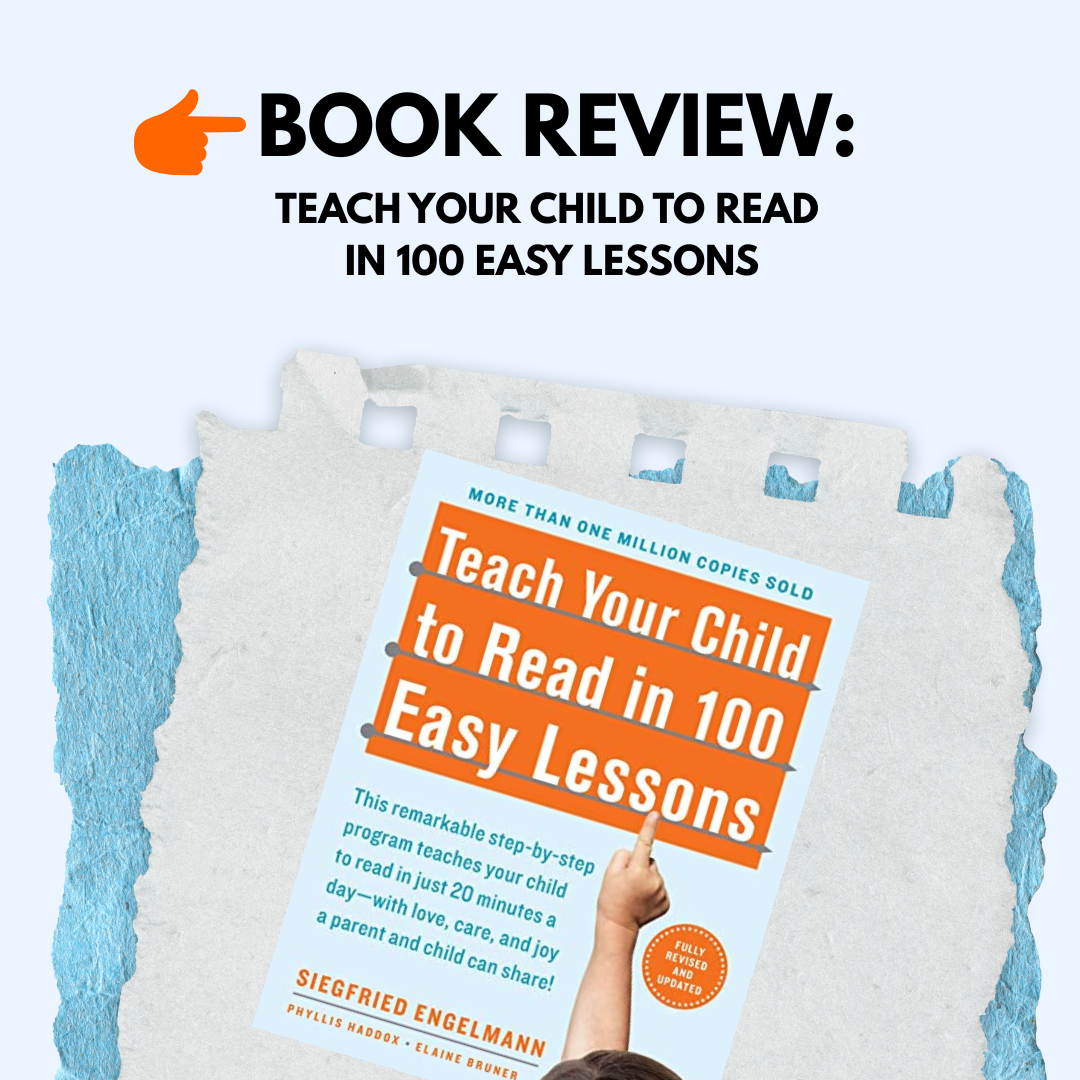
One of the most talked-about tools for doing just that is Teach Your Child to Read in 100 Easy Lessons by Siegfried Engelmann. You’ve probably heard about it from a friend, a homeschool forum, or an online parenting group. The title itself sounds promising—100 easy lessons!—but if you’ve peeked inside, you may have wondered whether it’s really as simple as it sounds.
Let’s look honestly at what makes this classic book work so well for some families—and where parents often run into trouble—so you can make an informed choice about your own child’s reading journey.
The Upside: Why Teach Your Child to Read in 100 Easy Lessons Has Endured
1) A proven, step-by-step structure
This program leaves very little to guesswork. Each of the 100 lessons tells you exactly what to say and what your child should do. For parents who crave clarity—or who feel intimidated by the idea of “teaching phonics”—that structure can be a lifeline. You don’t need a teaching degree; you just follow along, lesson by lesson, and watch your child begin to connect the dots (literally and figuratively).
Teach Your Child to Read in 100 Easy Lessons organizes lessons in a linear fashion, which is critical for a direct instruction, phonics-based method of teaching reading. Simply put, your child will start with the basics and build from there.
2) Phonics done right
The authors were pioneers of direct instruction—a method that builds strong decoding skills through explicit sound-symbol teaching. In a world where so many children struggle because they were never taught phonics well, this book’s systematic approach can be a godsend. Many parents have watched their children go from recognizing letters to reading short stories with a sense of pride and amazement.
3) Clear beginning and end to each lesson
At first, the sessions are short—about 15 minutes—and predictable. That rhythm can be reassuring for young learners and busy families alike. You don’t have to plan or gather supplies. You open the book, spend a few focused minutes together, and you’re done for the day. Consistency, not marathon sessions, is what builds confidence.
4) Scripts are written out for you
The beauty of a scripted program is that it takes the performance anxiety out of the equation. Many parents feel calmer knowing the words are right there on the page. You can sit beside your child, take a breath, and focus on connection instead of improvising lessons.
The Downside:
What Parents Often Find Challenging: Why Teach Your Child to Read in 100 Easy Lessons Might Not Be Right for You
Although Teach Your Child to Read in 100 Easy Lessons is a decent approach to teaching a child how to read, for some families, this book may pose a few challenges:
1) A bit dry for wiggly kids
Many families find the early lessons pleasant and quick—but around the halfway point, the workload ramps up. Words grow longer, stories stretch out, and lessons that once took 15 minutes can start running closer to 45. Parents often feel torn between keeping momentum and protecting their child’s love of learning.
It’s okay to slow down. The title may say “100 Lessons,” but no one said they have to happen in exactly 100 days.
3) The transition to “real” print
Early in the program, the book uses special symbols—dots and curved lines—to show children how to sound out words. It’s brilliant for teaching blending but can make the later shift to standard print tricky. Some children breeze through it; others stumble when those guides disappear.
4) No audio component
Unless you’re well-versed in phonics, you will need to get guidance from your child’s teacher (or another phonics expert) to learn how to pronounce the sounds correctly.
5) How much time do YOU have to spend on this?
As lessons become more cumbersome, your prep does, too. There is a lot you need to do to keep lessons lively and more engaging for your child.
6) One-size-fits-all pacing
The tight scripting that makes this program simple can also make it rigid. Every child learns at a different pace, and some need more hands-on practice or sensory input than a page of print can offer. Parents of active or easily distracted learners sometimes feel boxed in, unsure how to adapt without “breaking” the method.
Remember: you are your child’s best teacher. The book is just a guide. If you need to pause, repeat, or shorten a lesson, do it
A Balanced Verdict
So, is Teach Your Child to Read in 100 Easy Lessons a good choice? Absolutely—for many families. It’s straightforward, affordable, and phonics-based, which puts it far ahead of countless reading programs that overlook the science of how children actually learn to decode words.
If you love structure, enjoy following clear directions, and have a child who can sit for short bursts of focused attention, you might find this program a perfect match.
Want 6 Steps To Teach Your Child To Read Instead?
But if you crave something gentler, more flexible, or more interactive, you may find yourself adapting or supplementing more than you expected. That’s not a failure—it’s good teaching. Children are not assembly-line learners; they thrive when instruction fits their rhythm.
Read below to discover an easier, more gentle approach to teaching your child to read with phonics!
Try This Flexible & Fun Alternative To Teach Your Child To Read Quickly Now!


ASK MOM: DAUGHTER FAVORS DAD, MOM RESENTS IT
Daughter Favors Dad, Mom Resents Itby Mary Follin and Erika GuerreroRead more ASK MOM on Fredericksburg Parent & Family THE PROBLEM: My 3 yo daughter likes her father better than me. I’m embarrassed to admit this, but sometimes it makes me angry. I do most of...

ASK MOM: “BAD MOM” SUFFERS EXTREME MOM GUILT
"Bad Mom" Suffers Extreme Mom Guiltby Mary Follin and Erika GuerreroRead more ASK MOM on Fredericksburg Parent & Family THE PROBLEM: I feel like a bad mom. I can never keep up with things—school lunches, laundry, getting dinner on the table—all the normal stuff...

ASK MOM: CHILD DESPERATE NOT TO GO BACK TO SCHOOL
Child Desperate Not to Go Back to Schoolby Mary Follin and Kristi CrossonRead More ASK MOM advice in Fredericksburg Parent & Family Magazine THE PROBLEM: My 9-year-old son has always hated going to school. He’s awkward in a group, and he pretty much keeps to...
Read below to find out how Teach Your Child to Read In 6 Steps uses modern teaching techniques to make it much easier to teach your child to read!
Teach Your Child to Read is a 6-STEP online phonics program that makes teaching reading easy for you and fun for your child.
Rather than teaching your child ‘textbook’ style as in Teach Your Child to Read in 100 Easy Lessons, you will be presenting reading concepts in fun, cozy ‘micro lessons’ that bring reading skills alive!

Free 2-Step Phonics Starter Guide
You can teach your child to read at home—even if you’ve never taught phonics before. This quick-start guide gives you the first two steps of the program, plus audio samples so you know exactly how to present the lessons to your child.
Your FREE Starter Guide includes:
- Simple instructions for teaching individual letter sounds
- How to help your child blend sounds into real words
- Audio samples to clarify instructions
- Tips for keeping lessons short, fun, and stress-free
With just these 2 simple steps, your child will begin sounding out real words—right away.
How is Teach Your Child to Read In 6 Steps Different from ‘Teach Your Child to Read in 100 Easy Lessons’?
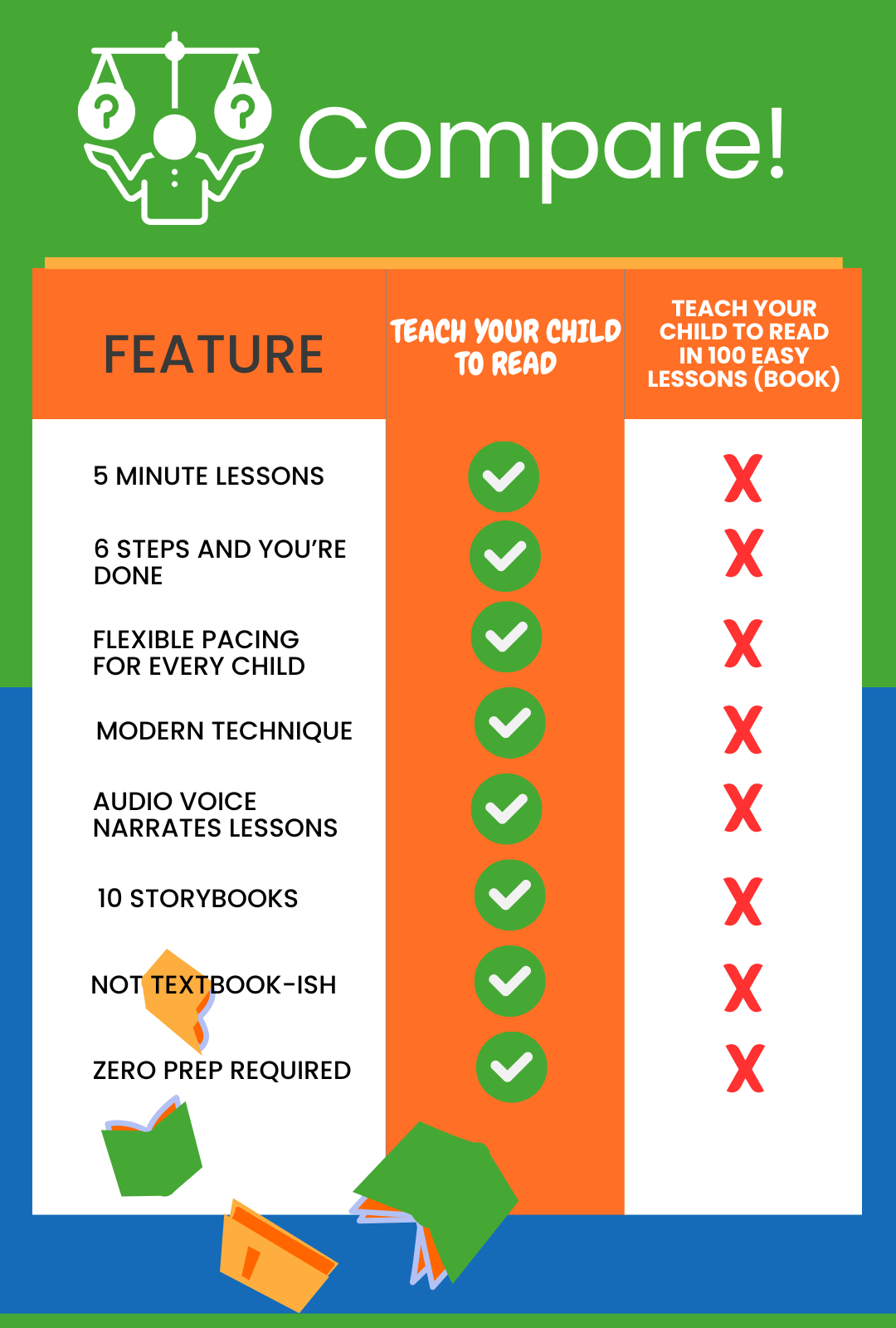
When I created Teach Your Child to Read, I wanted to keep what works about Teach Your Child to Read in 100 Easy Lessons—a traditional approach to teaching phonics—but remove the parts that make parents (and kids) dread lesson time.
Here’s how how my program gently fills those gaps:
-
Five-minute lessons that fit real life
The time commitment is intentionally small. Short, daily micro-sessions keep the mood light and consistent—no power struggles, no marathon drills. -
Connection before correction
Reading time becomes bonding time. The program invites conversation, smiles, and eye contact, because a child who feels safe and seen learns faster. -
Easy for parents, too
About 10 minutes after ordering the program, you can start teaching your child to read! (Conversely, Teach Your Child to Read in 100 Easy Lessons is rather time-consuming—and daunting—for you to learn how to use and teach.) -
Guided by Audio
You will be gently guided through the entire program. No more guessing on how to pronounce the sounds. -
Real storybooks to read
Kids love the sweetly illustrated storybooks that come with the program. Parents love watching their child read the stories out loud.
The goal is not perfection; it’s progress. Only five minutes a day adds up to something extraordinary when it’s done with love and consistency.
Audio Visual Demonstration of Each Lesson
When you’re learning something new, isn’t it nice to have someone demonstrate each lesson for you? Just to make sure you’ve got the presentation right? In the upper-left corner of each STEP in Teach Your Child to Read, you can click on the cartoon character with the laptop to see an animated presentation of how to teach the lesson, something you can’t do with a paperback.
WATCH: Demonstration of how to teach STEP 1 to your child
Sample lessons are included with each step
5 Minute Lessons
Early on, Teach Your Child to Read made a commitment to the wellbeing of your child, which is why the program was designed for you and your child to do together, preferably with your child on your lap. In today’s busy world, children don’t get enough one-on-one time with their parents. Wouldn’t it be nice to have 5 minutes built into your schedule every day for you and your child to spend together?
The lessons in Teach Your Child to Read in 100 Easy Lessons are 20 minutes in length, which isn’t horrible. But honestly, do you have 20 minutes every day to spend on this? Does your child? In an ideal world, maybe. But in the real world, 20 minutes is tough to carve out.
I feel the maximum amount of time you should spend on teaching a 3-6 year old child to read is 5 minutes-a-day, which is why I designed the lessons to be completed in very short periods of time. While some of the lessons take 5 minutes, many are even shorter.
Lessons Are Guided by My Voice
How much do you really need to learn in order to teach your child to read? Some disciplines would lead you to believe you need to know quite a bit, including Teach Your Child to Read in 100 Easy Lessons. But that’s simply not true. I’ve stripped out what you DON’T need to know, so you can get straight to the lessons and develop your child into a reader fast. In fact, your child can actually learn to read in 6 STEPS.
I think you will find this approach the easiest one to use, and the easiest one for your child to learn. Within minutes of logging in for the first time, you will be ready to get started on STEP 1, lesson 1. You don’t need to know anything about phonics or teaching reading. My voice will be guiding you throughout the entire program!
While I do feel Teach Your Child to Read in 100 Easy Lessons is a fine way to go, I invite you to consider Teach Your Child to Read. The program takes a step-by-step approach to teaching phonics, and lessons are only 5 minutes-a-day, rather than 20. Plus, you won’t have to wait until lesson 100 to see results! The instructions are easier and more straightforward, and the audio component pronounces the sounds for you.
Modern Approach with Very Little Screen Time
And screen time? Minimal. Since lessons are 5 minutes or less, you can actually do your lessons standing up—or even on the go. And once your child progresses in his or her reading skills, Teach Your Child to Read includes 10 e-storybooks for your new reader to enjoy.